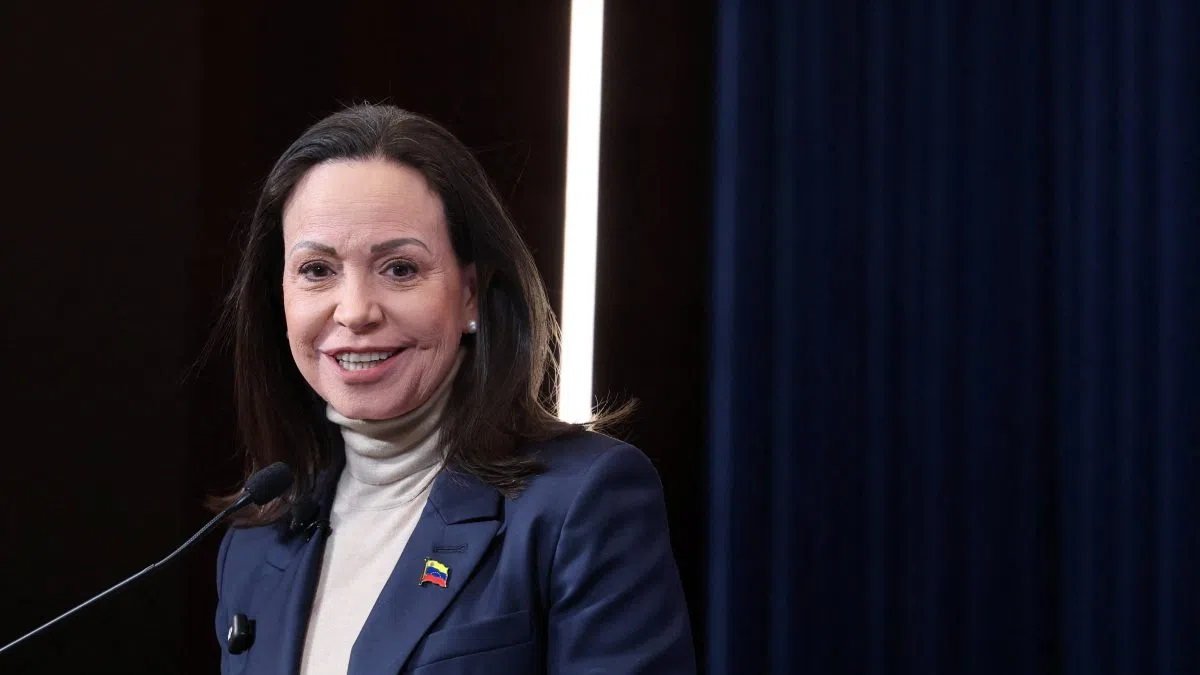
Venezuelan opposition leader and 2025 Nobel Peace Prize laureate Maria Corina Machado arrives in Washington amid tense negotiations over her country’s future. Her visit coincides with U.S. debates over Venezuela’s leadership following Nicolás Maduro’s removal from power.
Machado’s presence in the U.S. capital comes after a turbulent year in Venezuelan politics. Just 12 months ago, she was campaigning in Caracas, striving to galvanize citizens against Maduro as he began a third term despite contested election results. Her candidate, Edmundo González, had reportedly won a decisive victory, yet Maduro’s administration maintained power, leaving Machado sidelined and largely out of the public eye until she resurfaced in Norway last month to accept her Nobel Prize. Her dramatic escape from Venezuela to claim the award highlighted both her resilience and the precariousness of her position.
Despite her global acclaim, Machado remained on the sidelines while the U.S. carried out an extraordinary mission that led to the capture of Maduro and his wife, relocating them to New York to stand trial on narcoterrorism and drug trafficking accusations. Although Maduro is now in custody, his loyalists still wield power in Caracas, creating obstacles for Machado’s political aspirations.
The intricate equation behind U.S. support
Throughout this period, Maria Corina Machado aimed to preserve her rapport with the Trump administration. She openly supported specific White House measures targeting alleged Caribbean narcotraffickers and, in a contentious gesture blending strategy and admiration, dedicated her Nobel Prize to President Trump. However, once Maduro was ousted, the administration chose not to endorse Machado but instead backed Delcy Rodríguez, Maduro’s long-serving deputy.
Rodríguez’s rise illustrates the intersection of political pragmatism and U.S. strategic interests. While Machado is celebrated for her moral authority and international accolades, she lacks the connections within Venezuela’s military and security forces that Trump reportedly prioritizes. Rodríguez, conversely, has cultivated relationships and demonstrated loyalty to U.S. objectives, including facilitating oil exports and maintaining channels of communication with American officials. Her ascent underscores the administration’s focus on stability and economic opportunity over ideological alignment with democratic reformers.
Machado’s Nobel Prize, although globally recognized, is complicated in Washington’s political context. Trump himself has expressed personal disappointment at not receiving the award, adding an unpredictable dimension to Machado’s efforts to leverage her honor for political influence. Sources indicate that, as of recent weeks, she has not directly communicated with the president since dedicating her award to him, leaving her in a delicate position as she seeks to regain traction in U.S. policymaking circles.
Challenges in regaining influence
Machado’s bid to obtain Trump’s backing encounters major hurdles, as she has publicly denounced Rodríguez’s rise and emphasized her ties to El Helicoide prison along with the U.S. sanctions imposed in 2017 for human rights abuses; however, such objections may carry little influence with a U.S. administration that places stronger priority on securing access to Venezuela’s oil and preserving ongoing governmental cooperation rather than upholding democratic standards.
The White House appears convinced that Machado cannot command sufficient loyalty from Venezuela’s military and security apparatus to govern effectively if Maduro were removed. Rodríguez, by contrast, has spent years demonstrating her reliability and strategic alignment with U.S. objectives, including facilitating oil shipments and coordinating economic appointments favorable to American companies. A recent visit by U.S. chargé d’affaires Joe McNamara to Caracas signaled a willingness to reopen diplomatic channels under Rodríguez’s oversight, further reinforcing her advantage.
Although these obstacles remain, Machado still holds several advantages. Her long-standing ties to influential figures like Senator Marco Rubio give her a circle of political allies in Washington. She also benefits from in-person access to the president, a rare chance to shape perceptions and directly steer decisions, whereas Rodríguez has had fewer opportunities to do so, as her interactions with Trump have largely taken place over the phone.
Deliberate strategy and nuanced political judgment
Machado’s strategy in Washington calls for precise timing and carefully framed communication. Since Trump often bases his decisions on personal impressions, her public credibility and her Nobel recognition position her well to present a persuasive argument. Because Trump’s foreign policy tends to shift quickly, as shown in his responses to earlier crises and current conflicts, alliances and priorities can change without warning, giving Machado potential opportunities to extend her influence.
Although she does not yet command Venezuela’s power structures or its profitable oil sector, Machado’s focus on moral legitimacy, global visibility, and targeted advocacy could help her gain traction. Her ability to exploit Rodriguez’s weaknesses while presenting herself as a credible blend of principle and pragmatism may appeal to influential actors looking for stability without distancing democratic audiences.
In the volatile landscape of U.S.-Venezuelan relations, Machado’s challenge is to translate symbolic power into practical leverage. She must navigate a complex political environment, balancing criticism of Maduro’s regime with overtures to a U.S. administration that values operational reliability and economic returns. Her visit to Washington represents both a testing ground and a strategic opportunity to reposition herself in the eyes of the administration and broader international community.
Maria Corina Machado’s journey over the past year has been marked by personal risk, international recognition, and political uncertainty. As she engages in high-stakes discussions in Washington, she must reconcile her status as a Nobel laureate with the practical realities of U.S. foreign policy priorities. Rodríguez’s current advantage underscores the administration’s preference for operational stability and economic cooperation over democratic credentials alone.
Nevertheless, Machado’s access to influential policymakers, her public visibility, and her strategic acumen provide her with tools to advocate for her vision for Venezuela’s future. Her ability to convert international prestige into tangible political influence will determine whether she can regain a central role in shaping the country’s trajectory. In a political landscape defined by rapid shifts and competing interests, Machado’s resilience and strategic calculation may yet position her as a key figure in U.S.-Venezuelan relations.
The most recent leader who miscalculated her resolve now confronts the repercussions of underestimating her sway, serving as a pointed reminder of how steadfastness, standing, and diplomatic acuity can shape international affairs.