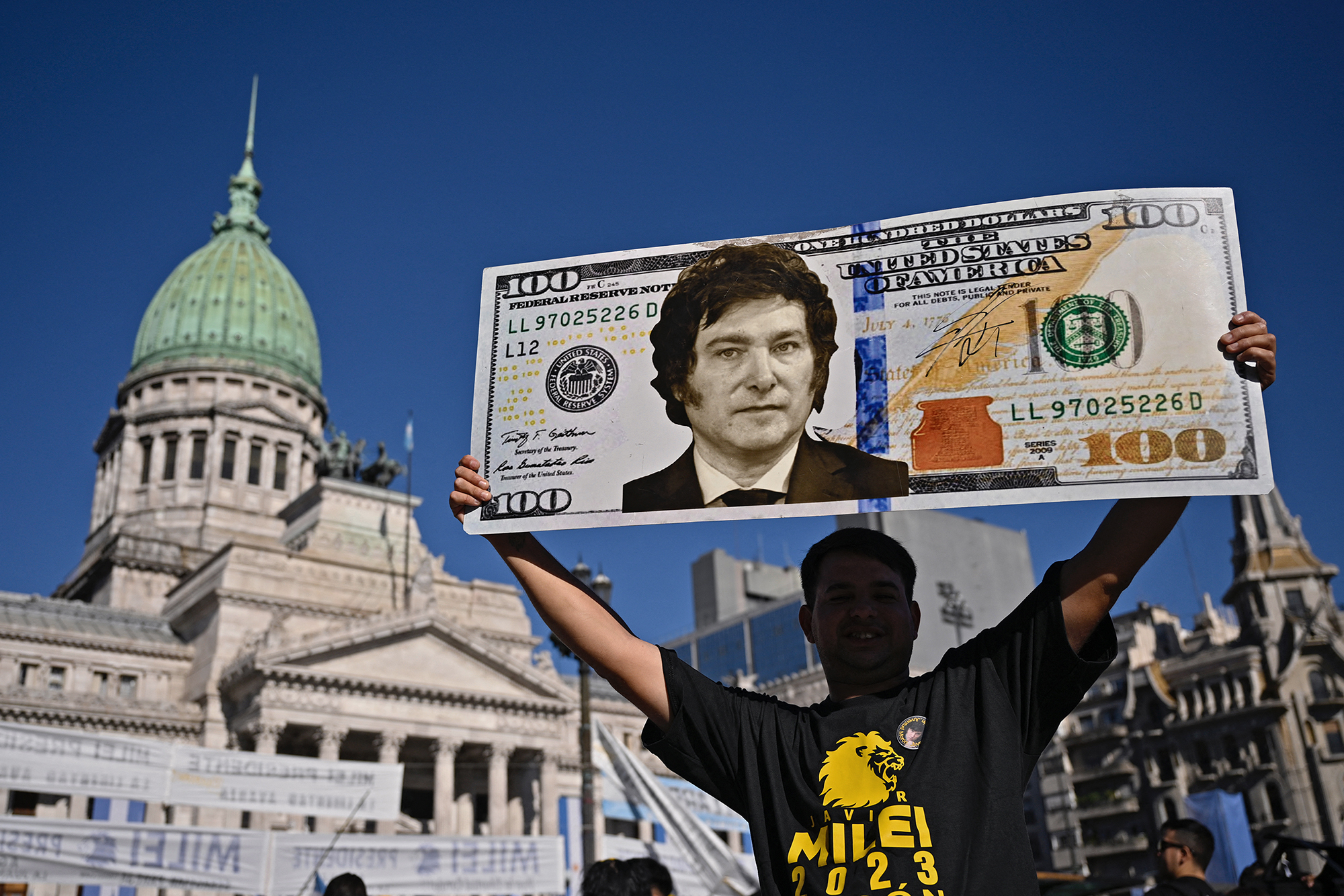
Former U.S. President Donald Trump has introduced a proposal to eliminate visa restrictions for Argentine nationals, signaling support for the conservative leadership of Argentina’s President Javier Milei. This announcement comes at a politically charged moment, reinforcing Trump’s alignment with like-minded populist figures abroad and illustrating shifting priorities in U.S.-Argentina relations.
Trump’s plan indicates a major change in policy: offering Argentina better terms for travel and immigration to the United States. Although detailed information is still coming to light, this step is portrayed as an act of friendly intention towards Milei’s government, noted for its firm right-wing approach, focus on removing regulations, economic liberalization, and challenge to leftist politics in Latin America.
The scheduling of the proposal is crucial. Milei, who assumed leadership during a period of soaring inflation and widespread public dissatisfaction, has implemented bold changes aimed at overhauling Argentina’s economic landscape. His political approach—characterized by straightforward language, support for free-market policies, and nationalist overtones—has garnered both enthusiastic supporters and strong opposition. Trump’s open support for Milei therefore strengthens mutual ideological values and solidifies international relationships within the global conservative alliance.
Trump’s declaration highlights two main objectives: simplifying travel restrictions and enhancing political alignment. He referred to Argentina as a nation experiencing significant political transformation, implying that altering visa policies would symbolize U.S. acknowledgment of reform initiatives. Although some critics warn against using visa policy as a form of diplomatic incentive, Trump portrayed the plan as a tactical action to back shared political principles and regional sway.
The announcement underscores broader themes in contemporary U.S. foreign policy discourse. Trump has increasingly leaned toward transactional diplomacy—offering incentives or punishments tied to political alignment or policy preferences. In this case, the proposal binds immigration policy to ideological cooperation, a marked departure from traditional visa considerations based on family, education, employment, or humanitarian need.
Reactions within Argentina have been mixed. Supporters of Milei see the measure as international validation, a tangible sign that the country’s shift toward economic liberalism and conservative governance is being acknowledged by influential actors abroad. Several Argentine lawmakers echoed that view, describing the proposal as a welcome opportunity to deepen bilateral ties and expand people-to-people exchange.
Nevertheless, opponents expressed worries about the possible example this policy could establish. Critics claim that associating visas with political beliefs weakens the humanitarian and merit-based fundamentals of immigration. They question which other international political leaders might pursue comparable arrangements and if U.S. immigration policy is at risk of turning into an instrument for partisan international interference.
Analysts are also attentive to legal and bureaucratic hurdles. Visa regulations are governed by federal law and require coordination across several agencies including the State Department and Department of Homeland Security. Implementing wide-scale visa exemptions or fast-tracked access for Argentine passports would also involve Congressional review or changes to administrative protocols—steps that are neither instantaneous nor guaranteed.
Beyond diplomatic optics, the proposed shift may have economic implications. Facilitated travel from Argentina could benefit sectors such as tourism, business investment, and academic exchange. Professionals, students, and entrepreneurs might gain easier access to U.S. markets and educational opportunities. Conversely, concerns exist over unintended consequences, including labor market effects or security oversight challenges, should vetting protocols be relaxed or exceptions broadly applied.
The wider context of the announcement points to growing alignment between populist leaders in North and South America. Milei’s presidency in Argentina echoes Trump’s own political style: bold nationalism, anti-establishment language, and polarization of political debate. Trump’s endorsement by offering visa concessions sends a signal to similar movements regionally, encouraging alliances across borders based on ideological affinity rather than traditional diplomacy.
In American politics, the proposal is receiving close attention from both sides of the party spectrum. A number of Republican leaders have applauded the initiative, viewing it as a strong show of support for conservative groups abroad and a measure to counteract the influence of left-leaning ideologies in Latin America. They consider the policy a continuation of domestic cultural politics applied to forging international alliances.
Democrats, on the other hand, have voiced worries that immigration policy ought to be distinct from geopolitical strategies. They claim that the process of obtaining a visa is a matter of regulations and procedure—not an instrument for compensating political partners. Legislators from both sides have also emphasized the necessity of maintaining impartiality and consistent criteria for all individuals seeking visas, cautioning against previous actions that might undermine confidence in the immigration framework.
Advocates for human rights have introduced a new perspective to the discussion. Although they acknowledge Argentina’s democratic validity, they warn that linking visa benefits to particular administrations might reduce accountability. A neutral stance in immigration policies enables the United States to uphold firm standpoints on human rights, concerns about the rule of law, or issues of electoral integrity—values that could be jeopardized if citizenship benefits turn into political incentives.
As discussions persist, practical queries remain unresolved. How might visa relaxation be organized? Would it encompass a wide range of individuals or focus on particular categories such as business travelers, students, or participants in cultural exchanges? What oversight measures would prevent misuse, fraud, or avoidance? Furthermore, would this policy be retractable if Argentina’s political course changes or internal conditions worsen?
One potential strategy involves a gradual rollout, beginning with pilot initiatives for educational or work visas, then expanding gradually according to compliance and administrative evaluations. An alternative strategy might involve forming regional immigration agreements within the Americas, suggesting mutual access arrangements under specifically outlined criteria. Every situation involves compromises between diplomatic signaling, legal practicality, and managing risk.
In a broader perspective, Trump’s initiative signifies more than just friendly relations between two countries—it embodies a contemporary technique of soft power. Instead of depending solely on financial assistance or multilateral institutional involvement, officials are exploring immigration policies as a means of exerting influence. Experts note that these methods might integrate into a wider strategy, utilizing visa benefits, access to markets, or regulatory leniency as methods to cultivate international ideological alliances.
Importantly, the statement highlights the changing dynamics of global populism. With figures such as Trump in the U.S. and Milei in Argentina adopting anti-globalist language and economic nationalism, visa regulations transform into a platform for indicating shared viewpoints. For grassroots advocates, easing visa restrictions may represent a triumph of ideology; for detractors, it implies a merging of immigration decisions with political agendas.
As the discourse unfolds, attention will turn to legislative actions, procedural decisions within the White House and agencies, and public response on both sides of the hemisphere. Will Trump’s proposal see formal adoption, and if so, in what form? How will Argentina respond from Milei’s administration? And how might other nations seek to replicate or resist such political immigration incentives?
The outcome of this proposal may shape broader norms about the role of ideology in immigration policy—whether supporting allied political movements through visa access becomes a recurring strategy or remains a political novelty. For now, Trump’s announcement marks a bold intersection of domestic political commentary and international diplomacy—a clear testament to how leadership figures may seek to reimagine traditional policy tools in service of aligned ideology.
Donald Trump’s plan to lift visa restrictions for Argentina signals strong praise for Javier Milei’s government while raising critical questions about the role of immigration policy in ideological diplomacy. Whether the proposal becomes policy or remains symbolic, it underscores a growing trend: the fusion of immigration decisions with political identity and global partisanship.